Neurotoxins: Which is Best for You? Your Comprehensive Guide to Personalized Anti-Aging Treatments in NYC
Neurotoxins—commonly known by brand names like Botox, Dysport, and Xeomin—are injectable neuromodulators used to soften dynamic wrinkles by temporarily reducing muscle activity. This guide explains how neurotoxins work, compares the leading Botulinum Toxin Type A formulations, and provides a practical framework to choose the best option for your facial anatomy and goals. Many New Yorkers seeking natural-looking anti-aging results worry about frozen expressions or inconsistent outcomes; understanding diffusion, onset, dose strategy, and treatment area specificity reduces those risks. We’ll cover the biological mechanism, head-to-head differences, area-specific recommendations, a patient-centered decision checklist, cost and membership models in NYC, and practical pre/post treatment steps. Throughout, expect clear comparisons for forehead lines, glabella, crow’s feet, lip flips, gummy smiles, and masseter reduction, plus guidance on when to book an in-person consultation for personalized dosing and conservative, natural results.
What Are Neurotoxins and How Do They Work for Wrinkle Reduction?
Neurotoxins are injectable formulations of Botulinum Toxin Type A that reduce visible dynamic wrinkles by interrupting neuromuscular signaling, producing targeted muscle relaxation and softer lines. The mechanism is straightforward: the toxin blocks acetylcholine release at the neuromuscular junction, causing temporary weakness of overactive facial muscles and thereby smoothing the skin above them. This targeted muscle modulation treats dynamic rhytides—lines that appear with expression—while allowing passive skin tone to remain. Safety relies on precise dosing, correct injection points, and experienced technique to preserve natural movement; when administered properly, neurotoxins offer predictable, reversible aesthetic improvement. Understanding this mechanism clarifies why product selection and injector skill matter for both efficacy and preservation of facial expressivity.
Neurotoxins are commonly used for both cosmetic and therapeutic indications, bridging aesthetic goals with functional benefits. The next subsections define the active ingredient class and explain the neuromuscular physiology that produces visible changes.
What is Botulinum Toxin Type A and its role in aesthetics?
Botulinum Toxin Type A is a neurotoxic protein used in medicine in controlled, purified doses to achieve localized muscle relaxation for aesthetic and therapeutic benefits. In aesthetics, commercial formulations of Botulinum Toxin Type A have become the standard for reducing dynamic forehead lines, glabellar frown lines, and lateral crow’s feet, and they are also used for precision procedures like lip flips and jaw slimming. Regulatory approvals and decades of clinical use have established the safety profile of these agents when properly dosed and administered by trained clinicians. The active molecule acts at the neuromuscular junction, and brand formulations differ in presentation and accessory protein content, which can influence handling and injector technique.
This functional background leads directly into how the toxin actually blocks muscle contraction at a cellular level and why that produces wrinkle reduction.
How do neurotoxins relax muscles to reduce dynamic wrinkles?
Neurotoxins interrupt the nerve-to-muscle signal by preventing the neurotransmitter acetylcholine from being released into the synaptic cleft at the neuromuscular junction, interrupting the cascade that causes muscle contraction. Concretely, following injection the toxin is internalized by motor nerve terminals, cleaves SNARE proteins required for vesicle fusion, and reduces synaptic transmission—this sequence produces predictable, temporary muscle weakening over days to weeks. Clinically, weakening of the corrugator muscles reduces glabellar lines visible when frowning, and relaxation of orbicularis oculi softens crow’s feet during smiling. Because the effect is reversible, dosing is conservative and adjustable; this preserves natural expressions while improving dynamic lines and sets up predictable follow-up maintenance.
Understanding this physiology helps explain practical differences among specific brands and why diffusion and dosing strategies matter across facial zones.
How Do Botox, Dysport, and Xeomin Differ? Key Features and Benefits
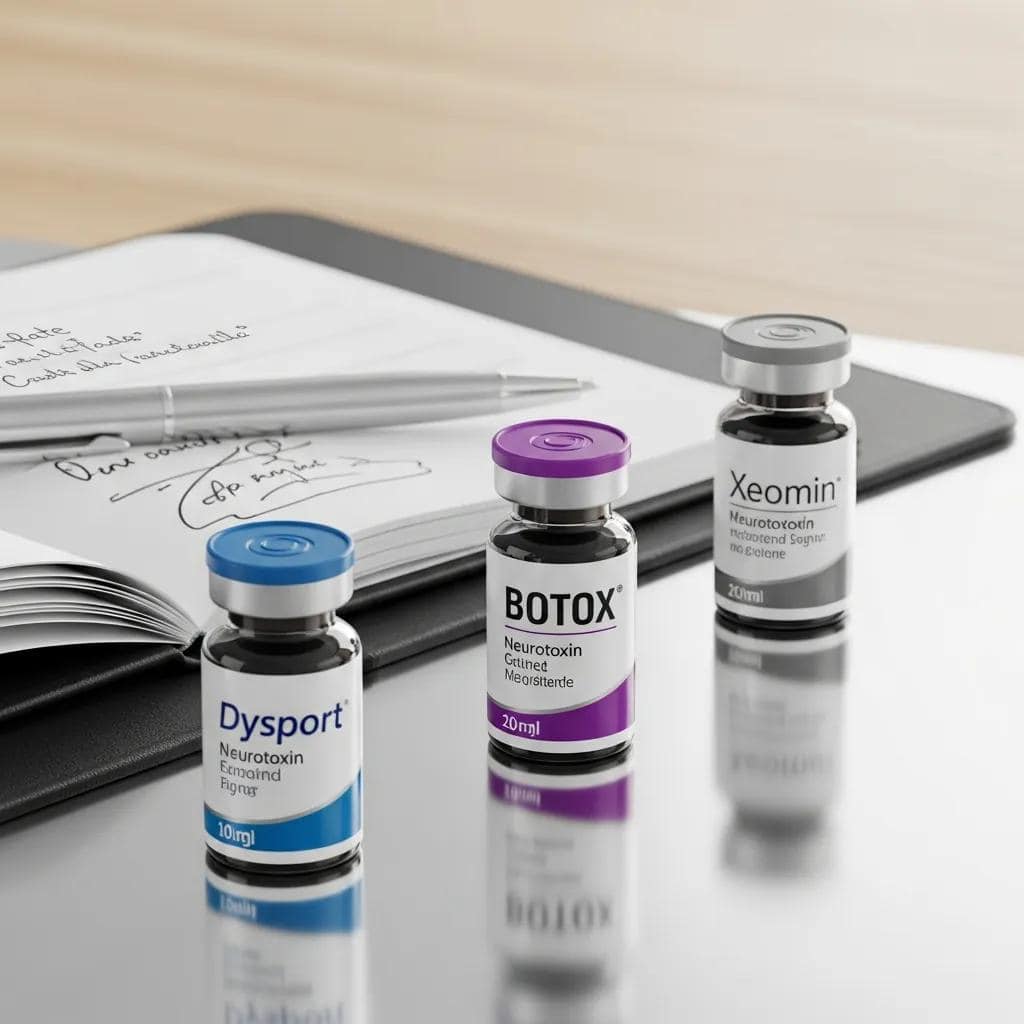
Botox, Dysport, and Xeomin are all Botulinum Toxin Type A products with subtle formulation differences that influence diffusion, handling, and injector preference. At a high level, differences include accessory protein presence, relative diffusion characteristics, onset timing, and labeled duration—factors injectors use together with anatomy and dosing to choose a product. Clinically, those distinctions guide product selection for focal precision versus broader lateral spread, and for patients prioritizing faster onset or a particular durability profile. Below is a concise table that captures the primary comparative attributes and a short summary of the implications for clinical selection.
Different neurotoxin formulations bring slightly different trade-offs that injectors weigh when tailoring treatment plans for specific areas and movement patterns.
| Product | Active ingredient | Diffusion / Spread | Protein accessory content | Typical onset | Typical duration | Ideal treatment areas |
|---|---|---|---|---|---|---|
| Botox (OnabotulinumtoxinA) | OnabotulinumtoxinA | More focal, less lateral spread | Contains accessory proteins | 3–7 days | ~3–4 months | Glabella, precise forehead work, small areas |
| Dysport (AbobotulinumtoxinA) | AbobotulinumtoxinA | Tends to diffuse more laterally | Contains accessory proteins | 2–5 days | ~3–4 months | Larger areas, lateral crow’s feet, masseter patterns |
| Xeomin (IncobotulinumtoxinA) | IncobotulinumtoxinA | More focal due to ‘naked’ formulation | Minimal to no accessory proteins | 3–7 days | ~3–4 months | Precision work, patients concerned about immunogenicity |
This comparison helps explain why an experienced injector may select one product over another based on the treatment area and desired diffusion profile, and it leads into more granular molecular and timing distinctions.
What are the molecular and diffusion differences among Botox, Dysport, and Xeomin?
Molecularly, the main distinction involves accessory proteins: Xeomin is formulated as a purified ‘naked’ neurotoxin without complexing proteins, while Botox and Dysport include accessory proteins in their formulations. The presence or absence of accessory proteins can influence theoretical immunogenicity and handling, although clinically all three are well-established when used appropriately. Diffusion—the lateral spread of effect after injection—varies among brands and is also influenced by dose, dilution, injection depth, and tissue characteristics; Dysport is generally considered to show greater lateral spread at comparable labeled units, which can be advantageous for larger or more diffuse muscle groups. These molecular and diffusion traits inform injector technique and the safety margin for adjacent structures.
Appreciating these differences in formulation explains why onset and longevity can vary and why injectors may select different products for large versus small target zones.
How do onset, duration, and protein content vary between these neurotoxins?
Onset and duration overlap substantially across the three products but have practical nuances: Dysport often demonstrates a slightly faster observable onset in some patients (sometimes within 24–72 hours), while Botox and Xeomin typically show effects within 3–7 days. Duration for most aesthetic indications averages around three to four months, though individual metabolism, dose, and treatment area can extend or shorten that window. Protein content differences (accessory proteins vs. naked toxin) influence theoretical immunogenicity; long-term resistance is rare but may be a consideration for patients receiving frequent, high-dose therapeutic treatments. Ultimately, patient-specific factors and injector technique are the strongest determinants of onset and longevity.
These timing dynamics feed directly into treatment planning for specific facial zones, which we’ll map next.
Which Neurotoxin is Best for Your Specific Treatment Areas?
Choosing the best neurotoxin for a given facial zone depends on diffusion needs, muscle mass, precision required, and esthetic goals. For wider muscles or when a bit more lateral spread is beneficial, a formulation with a greater diffusion profile may be chosen; for delicate, precision areas a more focal agent and conservative microdosing preserve natural expressions. Practical recommendations vary by zone—forehead lines require conservative dosing to avoid brow heaviness, glabellar lines need precise focal injections to prevent eyelid ptosis, and crow’s feet benefit from lateral placement with attention to orbicularis oculi dynamics. Below is a compact mapping of neurotoxin choice to common treatment areas to orient decision-making.
| Neurotoxin | Treatment Area | Typical Use / Recommendation |
|---|---|---|
| Botox | Forehead lines | Conservative units, focal placement to preserve forehead mobility |
| Dysport | Crow’s feet, larger lateral zones | Useful when broader lateral spread is helpful to cover wider muscle areas |
| Xeomin | Lip flip, gummy smile, precision small areas | Preferred when highly focal, minimal diffusion is desired |
The mapping above demonstrates how diffusion and focality guide product selection and sets the stage for area-specific technique notes in the subsections.
Forbidden Well integrates a conservative, custom-dosing philosophy when selecting products for each treatment area and offers Botox, Dysport, and Xeomin as part of its aesthetics menu. Their approach emphasizes brief 15–30 minute sessions and tailored dosing designed to produce natural results, and patients are encouraged to book a consultation to match product choice to anatomy and goals.
How do Botox, Dysport, and Xeomin address forehead lines, glabellar lines, and crow’s feet?
Forehead lines require a conservative, balanced approach because overtreatment can limit brow elevation and create a heavy or flattened appearance; injectors often favor focal dosing with a product that allows precise placement. Glabellar (frown) lines are treated with highly focal injections into the corrugator and procerus muscles, where preventing diffusion to the levator palpebrae superioris is critical to avoid eyelid ptosis. Crow’s feet are lateral and may tolerate slightly more diffusion; careful lateral placement and attention to orbicularis oculi anatomy prevent spread into zygomaticus muscles that could affect smile dynamics. Across these zones, microdosing and conservative initial units allow for touch-ups rather than overtreatment, preserving expressive movement.
These region-specific tactics illustrate why injector experience and individualized technique are essential before selecting a product and dose.
What neurotoxin options are ideal for lip flip, gummy smile, and masseter reduction?
Smaller functional procedures like a lip flip or correction of a gummy smile require highly focal injections with small unit counts to the orbicularis oris or levator labii superioris muscles, emphasizing precision over diffusion. Xeomin or Botox are commonly selected for these microdosing treatments because clinicians favor minimal lateral spread and fine motor preservation in perioral regions. Masseter reduction for jaw slimming involves larger volumes placed in the masseter muscle with staged treatments to observe progressive atrophy and functional adaptation; Dysport’s diffusion profile can be useful for broader muscle coverage, but choice depends on clinician preference and dosing strategy. In all cases, conservative initial dosing with follow-up assessment reduces the risk of functional compromise while achieving aesthetic goals.
These practical examples lead into a patient-centered decision framework for choosing the best neurotoxin based on individual factors and consultation findings.
How to Choose the Best Neurotoxin for You: Personalized Factors and Consultation
Selecting the ideal neurotoxin is a personalized process that integrates anatomy, muscle strength, treatment goals, prior response history, lifestyle, and maintenance preferences. A stepwise decision flow begins with a dynamic facial assessment to map hyperactive muscle groups and quantify movement patterns, followed by discussion of goals—preventative smoothing versus corrective remodeling—and tolerance for downtime or transient asymmetry. Prior history of response to specific products, frequency of past injections, and any prior adverse effects inform product selection and dosing. Because many variables interact, an in-person consultation with an experienced injector remains the gold standard for arriving at a safe, effective, and tailored treatment plan.
- Determine your primary goal: prevention, softening, or structural change.
- Note any prior neurotoxin responses, including which product and outcome.
- Assess muscle mass and movement—stronger muscles often need higher units or staged treatments.
- Clarify desired onset and maintenance frequency to align with product durability preferences.
This checklist frames the topics to cover during a consultation and sets expectations for why an in-person assessment matters for optimal outcomes.
At Forbidden Well, personalized consultations are conducted by expert injectors who prioritize conservative dosing, natural results, and integration of neurotoxin treatments with broader wellness services and membership options. Booking an in-clinic assessment enables a tailored plan and access to concierge scheduling and membership benefits for ongoing maintenance.
What individual factors influence neurotoxin selection?
Several patient-specific variables influence product and dose choice: muscle mass and activity level, prior product response or resistance, the specific dynamic pattern of the target area, skin thickness, and the patient’s timeline for seeing results and maintaining outcomes. For example, a patient with heavy masseter muscles may require higher total units or repeated treatments, while someone seeking a lip flip needs a very small, precise dose to the orbicularis oris. Lifestyle factors—such as frequency of sun exposure, participation in high-intensity exercise, or scheduling around events—influence when and how treatments are planned. These factors together guide an injector toward a product and dosing plan that balances efficacy with natural movement preservation.
Recognizing these variables underscores why a personalized consultation is not optional but essential for safe, satisfactory aesthetic outcomes.
Why is a personalized consultation essential for optimal results?
A personalized consultation allows the clinician to perform a dynamic movement exam, map muscle anatomy, review medical history, and align expectations with achievable outcomes, thereby reducing the risk of unwanted side effects. During the visit, practitioners determine dosing, dilution, and injection vectors tailored to the individual, and they can simulate probable results and discuss staged approaches when needed. This direct assessment also provides an opportunity to explain membership or maintenance options and to schedule follow-up to refine results. Because remote advice cannot capture subtle anatomic asymmetries or tactile feedback, in-person evaluation materially improves predictability and satisfaction.
This emphasis on in-person evaluation naturally connects to practical considerations about cost models and membership benefits for ongoing maintenance in NYC.
What Should You Know About Neurotoxin Treatment Cost and Membership Benefits in NYC?
Neurotoxin pricing in NYC typically follows two basic models: per-unit pricing and flat-fee (per-area) pricing, each with trade-offs in transparency and predictability. Per-unit pricing charges by the vial unit and is useful when dosing varies significantly between patients; flat-fee pricing bundles an area-based treatment into a single price regardless of exact unit count. Factors that influence total cost include the treated area, total units required, injector experience level, and the need for staged sessions. Memberships in aesthetic practices are increasingly used as a value model for patients who plan regular maintenance; memberships can smooth costs, offer scheduling priority, and provide bundled discounts that support consistent, conservative upkeep.
| Service Option | Pricing Model | Membership Impact / Benefit |
|---|---|---|
| Per-unit billing | Price per unit charged; total varies by dose | Membership can offer discounted per-unit rates or credits for regular treatments |
| Flat-fee per area | Fixed price for a defined area (e.g., forehead, glabella) | Membership may include bundled area treatments or reduced fees for follow-ups |
| Bundled maintenance | Prepaid series for scheduled maintenance | Membership smooths cashflow, ensures continuity, and prioritizes scheduling |
This framework helps patients understand how pricing interacts with treatment planning and why experienced injector selection matters beyond headline price comparisons.
How is neurotoxin pricing structured at Forbidden Well?
Forbidden Well structures neurotoxin services to emphasize expert injector care, conservative dosing, and continuity through membership access; pricing reflects per-unit or per-area models combined with membership incentives for regular clients. Specific unit counts vary with anatomy and goals, so the practice recommends an in-person consultation to receive an accurate quote and treatment plan. Forbidden Well positions pricing around value—experienced injectors, short 15–30 minute sessions, and integrated wellness services like IV therapy and recovery support—to help clients evaluate cost in the context of quality and outcomes.
Explaining pricing this way clarifies why consulting with a clinic provides the most reliable cost estimate tailored to an individual plan.
What membership advantages are available for regular neurotoxin treatments?
Memberships at modern aesthetic practices commonly include benefits such as scheduling priority, discounted per-unit rates or bundled pricing for maintenance, and access to concierge services or gift card options for ease of use. For regular neurotoxin clients, membership supports predictable maintenance intervals—helping maintain natural results with staged, conservative dosing—and may include booking privileges that reduce wait times around busy NYC schedules. These perks are designed to align cost predictability with clinical continuity, enabling injectors to fine-tune dosing over time.
Memberships therefore act as both a financial smoothing tool and a continuity-of-care mechanism that supports long-term, natural-looking outcomes.
How to Prepare for and Care After Neurotoxin Injections for Safe, Natural Results

Proper preparation and aftercare reduce bruising, optimize efficacy, and minimize side effects, supporting safe and natural results. Key pre-treatment steps include disclosing medical history and medications, avoiding blood-thinning supplements and alcohol in the 24–48 hours before the appointment where safe to do so, and arriving with clean skin free of topical agents that could interfere with injection. After treatment, simple precautions—avoiding heavy exercise, not massaging treated areas, and sleeping with minimal pressure on the injection sites for the first night—help stabilize diffusion and reduce complications. Knowing expected transient side effects and when to contact your provider ensures rapid resolution of concerns and preserves results.
The following subsections provide actionable pre-treatment and post-care checklists and explain common timelines to set realistic expectations for outcomes.
What are the recommended pre-treatment guidelines?
Prepare for a neurotoxin appointment by reviewing medications and supplements with your clinician, as NSAIDs, aspirin, fish oil, vitamin E, and certain herbal supplements can increase bleeding risk and bruising; stopping these only when medically safe and advised is recommended. Avoid alcohol for 24–48 hours before treatment to minimize vasodilation and bruising, and arrive with clean, makeup-free skin to facilitate assessment and injection. Communicate any recent illnesses, prior neurotoxin experiences, or neurologic conditions, and disclose pregnancy or breastfeeding status, as those situations may change candidacy. Finally, plan your schedule for the day—expect a short 15–30 minute visit—and arrange a follow-up or touch-up window with your injector if adjustments are needed.
- Review and disclose medications and supplements with your injector.
- Avoid alcohol and heavy exercise 24–48 hours before the appointment.
- Arrive with clean skin and clear communication about prior treatments or conditions.
These preparation steps reduce adverse events and ensure the injector can implement a conservative plan tailored to your anatomy.
What post-care steps help minimize side effects and enhance outcomes?
After injections, apply a cold compress briefly to reduce swelling and avoid massaging or rubbing treated areas for at least 24 hours to prevent unintended product migration. Refrain from strenuous exercise, saunas, or heavy cardiovascular activity for 24–48 hours, and avoid lying face down for the first night to help the toxin settle in place. Expect mild bruising, tenderness, or transient headache in some patients; these symptoms usually resolve within a few days to two weeks. Contact your provider promptly if you experience unexpected weakness in adjacent muscles, visual changes, or signs of infection—timely evaluation allows rapid management and reassurance.
- Onset of visible effect: 1–7 days, depending on product and area.
- Peak effect: often around 1–2 weeks.
- Typical duration before retreatment: about 3–4 months, individualized by metabolism and dose.
Understanding the typical timeline for results and side effects helps patients plan follow-up and maintenance visits to preserve natural expression and long-term satisfaction.
- Follow-up & support: Patients receive guidance on when to return for adjustments.
- Concierge care: Membership clients gain streamlined scheduling for maintenance visits.
- Integrated wellness: Neurotoxin plans can align with other services such as IV therapy and recovery offerings for holistic results.